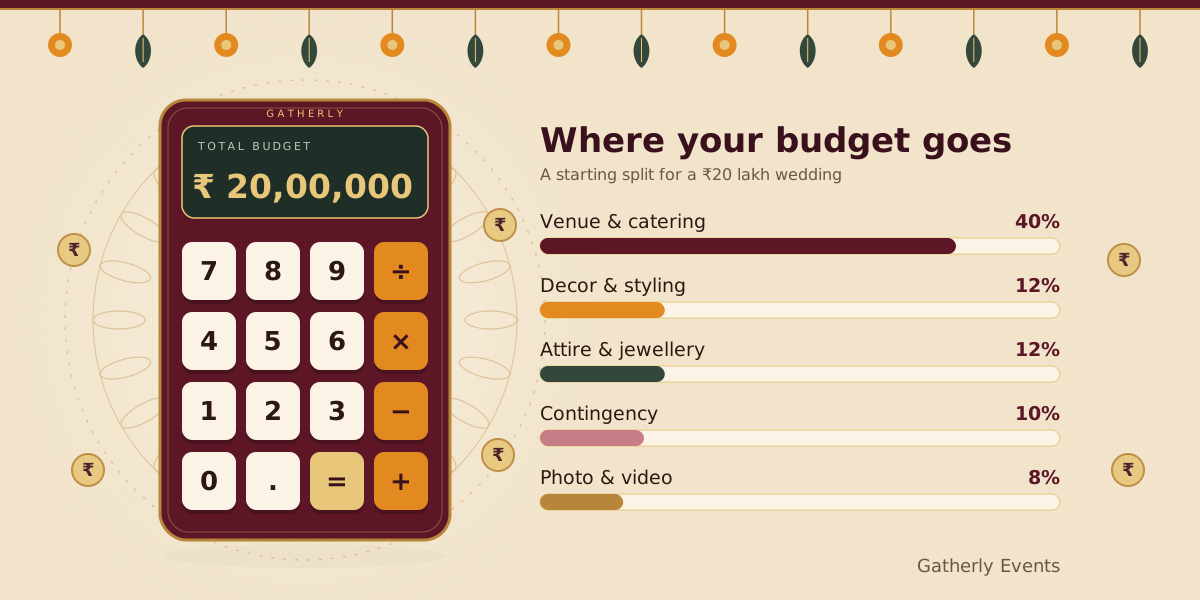
Most wedding budgets don't fail because the total was wrong. They fail because the total was never broken down, so nobody noticed catering quietly growing while decor shrank to fit. A budget calculator fixes that by putting every rupee into a category before you've booked anything. Here's how to use one well, and how the numbers usually fall in an Indian wedding.
Start with two numbers: your total and your guest count
Everything else follows from these. Your total is the figure both families are genuinely comfortable spending, not a stretch target. Your guest count matters even more than it looks, because it drives the biggest line items: food is charged per plate, venues are chosen by capacity, and out-of-town guests need rooms and transport. If you can only settle one thing early, settle the guest count. Trimming the list usually moves the total more than any decor decision.
Also decide which functions you're budgeting for. Mehndi, haldi, sangeet, the wedding itself and a reception each cost differently, and a sangeet with a full stage and a sit-down dinner is a very different spend from a daytime haldi at home. Give each function a rough share before you start collecting quotes.
Where the money usually goes
There's no single right split. It depends on your city, season, venue and how your families like to celebrate. As a starting point, here's an illustrative split for a ₹20 lakh wedding. Use the percentages to start the conversation, then move them to match your priorities.
| Category | Share | On ₹20 lakh |
|---|---|---|
| Venue and catering | 40% | ₹8,00,000 |
| Decor and styling | 12% | ₹2,40,000 |
| Attire and jewellery | 12% | ₹2,40,000 |
| Photography and videography | 8% | ₹1,60,000 |
| Guest travel, stay and transport | 6% | ₹1,20,000 |
| Music and entertainment | 5% | ₹1,00,000 |
| Bridal makeup and mehndi artists | 4% | ₹80,000 |
| Invitations and gifts | 3% | ₹60,000 |
| Contingency | 10% | ₹2,00,000 |
| Total | 100% | ₹20,00,000 |
Illustrative figures for planning only, not a quote. Real costs vary a lot with venue, season and guest count.
How to use a wedding budget calculator
- Start with your total and guest count. Every other number depends on these two.
- Set a share for each category. Begin from the split above and adjust. If decor matters most to you, take from another category rather than inflating the total.
- Check the result against real quotes. A calculator gives you a target. Quotes tell you whether the target is realistic for your venue and dates.
- Leave the contingency alone. Treat it as spent only when something genuinely unexpected comes up.
- Recalculate after each big booking. Once the venue is confirmed, work out what's left for everything else and adjust the remaining shares.
You can try this with your own figures using our wedding budget calculator.
Costs that catch families off guard
- Extra guests. Plates are charged per head, and the final count is almost always higher than the first list. A buffer of 5 to 10% is sensible.
- Venue rules and fees. Some venues charge extra for outside decorators or caterers, or set a minimum spend. Ask early what the venue fee actually includes.
- Overtime. A ceremony that runs late means overtime for decor crews, photographers and sound. Build slack into the schedule.
- Functions that quietly grow. A small mehndi at home becomes a catered evening with a stage. Decide the scale of each function before invitations go out.
- Late changes. Flowers and fabrics cost least when ordered early. Changing the palette in the last two weeks usually costs more.
- Guest logistics. Rooms, airport pickups and baraat transport are easy to forget and they add up.
- Taxes and service charges. Check whether each quote includes them, and get the answer in writing.
Ways to stretch the budget without it showing
- Spend where people look first. The entrance, the stage and the table settings do most of the work. Our guide to budget-friendly wedding stage decoration shows how to keep the rest simple.
- Be flexible on dates. Peak-season weekends cost the most. If your muhurat allows, a weekday or off-peak date can give you more room.
- Reuse decor across functions. Florals and fabrics from one function can often be restyled for the next when one team handles both.
- Trim the guest list before you trim quality. Fewer guests at a better table usually beats a crowd at a stretched one.
- Use one point of contact. A single planner coordinating decorators, caterers and makeup artists makes quotes easier to compare and avoids paying twice for the same thing. Our post on finding the right wedding planner in Delhi covers what to ask.